


Phillip Corallo-Titus on 40 Years at Chappellet
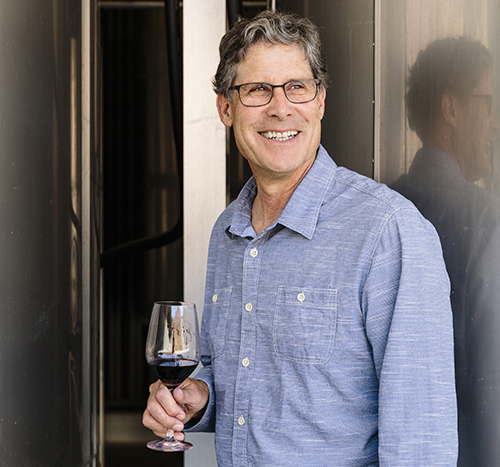
Phillip Corallo-Titus reflects on four decades at Chappellet
Phillip Corallo-Titus first arrived at Chappellet in 1981, a young winemaker eager to learn from Cathy Corison. He returned to Pritchard Hill as winemaker in 1990 and spent the next three decades helping transform the estate’s vineyards and wines.
Along the way, he witnessed extraordinary changes in Napa Valley, from the days when most vineyards were dry farmed to the rise of Pritchard Hill as one of the world’s most recognized sources of Cabernet Sauvignon.
Today, after four decades at Chappellet, Phillip serves as Senior Winemaking Advisor, working alongside winemaker Ry Richards and Director of Vineyard Operations Andrew Opatz. His transition out of the day-to-day winemaker role began with the 2023 vintage, the culmination of years spent preparing the next generation.
We sat down with Phillip to talk about his early days in Napa, the people who shaped his career, and what he’s learned from a lifetime of making wine on Pritchard Hill.
Growing Up in Napa Valley
Few winemakers have witnessed Napa Valley’s evolution as closely as Phillip. Long before Cabernet Sauvignon made the region famous, before tasting rooms lined the valley, and before Napa became one of the world’s most celebrated wine regions, he was a young boy growing up among orchards and farms. That changed when Phillip’s parents purchased a vineyard north of St. Helena in 1968. For his father, Lee, a radiologist by profession and farmer by passion, the vineyard represented an opportunity to build something lasting for his family. For Phillip, it opened the door to a world that would define his future.
Like many children growing up in Napa Valley at the time, Phillip spent weekends and summers working alongside his family in the vineyard. The work instilled a lifelong appreciation for agriculture and a deep connection to the land. Yet while he enjoyed farming, it was the winery that captured his imagination. “I was probably 12 when I first became fascinated by wine. That fascination only deepened as I grew older,” Phillip recalls. Encouraged by his father, he began visiting wineries throughout Napa Valley, captivated by the sights, aromas, and mystery of the cellar. “The vineyards weren’t mysterious to me,” he says. “Winemaking was. I loved visiting wineries. They were cold, damp, and often dark, and they smelled like old oak and fermenting grapes, and I loved it. To a young me, winemaking seemed like the dark arts. I wanted to be one of those guys.”
After high school, Phillip attended the University of California, Davis, where he studied agronomy, viticulture, and enology. Outside the classroom, he immersed himself in wine, pooling money with friends to buy bottles of Bordeaux and Burgundy, tasting and debating them late into the night. Those evenings broadened his understanding of what great wine could be.
Learning from Cathy Corison
After UC Davis, Phillip got his big break when he joined Chappellet in 1981 under then-winemaker Cathy Corison. Phillip credits Cathy with recognizing his enthusiasm and nurturing his potential. “Cathy took an interest in me,” he recalls. “I followed her around with a notepad asking questions all the time. She saw the fire in me.” Though Napa Valley’s wine community was still relatively small, Phillip suddenly found himself surrounded by people he viewed as giants of the industry, including Mike Grgich, Zelma Long, Tony Soter, and Joe Cafaro. “I’d meet them and be petrified. To me, they were stars, and I was in awe.” He quickly learned that great winemaking required both curiosity and commitment, a lesson he would carry with him throughout his career.
Napa Winemaking in the Early 1980s
Back then, things were very different. Grapes were harvested in large gondolas, not today’s microbins, and Chappellet’s vineyards, like most of those in Napa Valley, were farmed without irrigation. “Because everyone was dry farming, we had to pick at much lower sugar levels,” Phillip says. “The leaves on the vines would be brown and drying even if the grapes were only at 22 or 23° Brix. No one had even heard the words ‘phenolic maturity,’ and most everyone’s wines were under 14% alcohol.”
Even then, Phillip sensed that Chappellet was special. With their iconic pyramid winery and pioneering work with high-elevation winegrowing, Donn and Molly Chappellet had already established a reputation for innovation and a willingness to challenge convention. While many Napa Valley wineries were content with the status quo, there was a belief that Chappellet’s best days were still to come. “They had a vision for what the vineyard, the winery, and the wines could become. Everything was still evolving, and you could feel the energy and the tremendous potential.”
After four years honing his craft alongside Cathy, Phillip left Chappellet with Donn’s blessing in 1985, eager to broaden his experience before one day leading a winery of his own. Over the next five years, he worked at several respected wineries and traveled widely through Bordeaux and Burgundy. Seeing those historic estates deepened his appreciation for the connection between place and wine and reinforced his belief that Napa Valley’s greatest wines would one day stand alongside the world’s best.
Returning to Pritchard Hill in 1990
In 1990, Donn invited Phillip to return to Pritchard Hill as Chappellet’s winemaker, a title he would hold for the next 33 years. Phillip returned to a winery rich in history, but one he believed had yet to realize its full potential. Working alongside Vineyard Manager Dave Pirio, he set out to reexamine nearly every aspect of the estate’s viticulture and winemaking. Together, they challenged long-held assumptions about when to harvest, how to farm, which varieties belonged on Pritchard Hill, and what the wines could become. “We looked at everything,” Phillip says. “How can we make the grapes better? How can we make the wines better?” It wasn’t about dramatic changes overnight. It was about hundreds of thoughtful improvements that, over time, fundamentally reshaped the estate.
Replanting and Rethinking the Vineyards
Much of that work began in the vineyard. Phillip and Dave launched a long-term redevelopment program, replanting approximately five acres each year while carefully matching grape varieties, clones, rootstocks, row orientation, and trellis systems to each site’s unique soils and exposures. Chardonnay and Riesling gradually gave way to Cabernet Sauvignon and the classic Bordeaux varieties, with Petit Verdot and Malbec adding new dimensions to Chappellet’s wines. They also shifted their approach to farming and harvest, focusing less on sugar levels and more on flavor, balance, and physiological ripeness. Every improvement built upon the last, moving Chappellet one step closer to the vision Phillip, Dave, and the Chappellet family shared for the future.
A Shared Vision for Chappellet
The transformation of Chappellet was never the work of two people alone. While Phillip and Dave focused on elevating the vineyard and the wines, Donn’s pioneering vision continued to guide the winery, while Molly helped shape its character and reputation, sharing the beauty of life on Pritchard Hill through her acclaimed books, cultivating enduring relationships with wine lovers and influential leaders around the world, and bringing warmth, creativity, and a holistic vision that became inseparable from the Chappellet experience. At the same time, Cyril Chappellet, now the winery’s CEO, began taking on an increasingly active leadership role. Together, they shared a willingness to question convention, embrace new ideas, and continually raise expectations for what Chappellet could become. This mindset perfectly complemented Phillip’s own philosophy. Every improvement revealed the next challenge. As newly replanted vineyards matured, the wines reached new levels of color, concentration, and complexity. Better fruit demanded better equipment, which eventually led to a larger, modern winery.
Decades of Acclaim on Pritchard Hill
The timing proved fortunate. As Chappellet reimagined its approach to growing grapes and making wine, Pritchard Hill itself was emerging as one of the world’s great places to grow Cabernet Sauvignon. Phillip saw this as confirmation that Donn Chappellet’s original vision had been right all along. “We knew what we had,” he says. “Once those new vineyards came online, it felt like a renaissance at Chappellet.” By the late 1990s, the improvements taking place throughout the estate were evident in every bottle, laying the foundation for decades of acclaim.
Over the next two decades, this long-term vision continued to bear fruit. New vineyards matured, construction of a state-of-the-art barrel chai, led by Jon-Mark Chappellet, improved upon the constraints of the original pyramid, and Chappellet embraced new technologies while remaining true to the belief that great wines begin in the vineyard. As the estate continued to evolve, so did its reputation, with the winery earning the international acclaim and multiple 100-point scores that Donn and Molly had long believed were possible, including perfect scores for the 2012, 2015, and 2016 Pritchard Hill Cabernet Sauvignon and for the 1969 Cabernet Sauvignon. Most recently, the 2023 vintage earned 100 points from critics Jeb Dunnuck, Lisa Perrotti-Brown, and Jane Anson. Looking back, Phillip sees those achievements not as individual milestones, but as the cumulative result of thousands of decisions made over decades by people who shared a common vision.
Preparing the Next Generation
That same long-term perspective ultimately shaped Phillip’s approach to succession. Just as Cathy Corison had invested in a young assistant eager to learn, and just as Donn had entrusted him with the future of Chappellet in 1990, Phillip came to understand that part of his own responsibility was preparing the next generation. Over nearly two decades, he mentored Ry Richards, and in the years leading up to his transition into an advisory role, he also worked closely with Andrew Opatz to strengthen the partnership between the vineyard and winery. For Phillip, succession wasn’t simply about preparing a new winemaker. It was about building a leadership team united by a common philosophy, ensuring that vineyard and winery would continue moving forward together.
Phillip’s Role at Chappellet Today
Today, as Ry leads the winemaking team and Andrew oversees the estate vineyards, Phillip continues to serve as Senior Winemaking Advisor, confident that the close partnership he helped foster between the vineyard and winery will guide Chappellet well into the future. The transition represents something larger than a change in title. It is the culmination of years spent building a unified leadership team grounded in a shared philosophy and common purpose. Looking back on his four decades on Pritchard Hill, Phillip smiles when asked whether he accomplished what he set out to do.
“For a long time, I felt that I had unfinished business on Pritchard Hill,” he says. “Now I feel like we’ve built a foundation that is strong and enduring. We’ve reached the top of the mountain. It’s nice to be able to enjoy the view.”
Phillip Corallo-Titus’s Career Timeline
- 1968: Phillip’s parents purchase a vineyard north of St. Helena where he worked in his youth.
- 1981: Phillip joins Chappellet under then-winemaker Cathy Corison.
- 1985: He leaves Chappellet, with Donn Chappellet’s blessing, to work at other wineries and travel through Bordeaux and Burgundy.
- 1990: Donn Chappellet invites him back to Pritchard Hill as Chappellet’s winemaker.
- 2023: Phillip becomes Vice President of Winemaking.
- 2026: Phillip becomes Senior Winemaking Advisor.
Frequently Asked Questions
Who is the winemaker at Chappellet?
Ry Richards has been Chappellet’s winemaker since the 2023 vintage. He was mentored for nearly two decades by Phillip Corallo-Titus, who now serves as Senior Winemaking Advisor.
How long was Phillip Corallo-Titus the winemaker at Chappellet?
Phillip Corallo-Titus was Chappellet’s winemaker for 33 years, from 1990 to 2023 and then VP of Winemaking for an additional three years until 2026. Today Phillip works as our Senior Winemaking Advisor. He first joined Chappellet in 1981 under then-winemaker Cathy Corison and stayed until 1985.
Where is Chappellet located?
Chappellet is on Pritchard Hill in Napa Valley, California, where founders Donn and Molly Chappellet pioneered high-elevation winegrowing and built the winery’s iconic pyramid.
What grape varieties does Chappellet grow on Pritchard Hill?
Under Phillip Corallo-Titus and Vineyard Manager Dave Pirio, Chappellet’s vineyards shifted their focus toward Cabernet Sauvignon and the classic Bordeaux varieties, including Petit Verdot and Malbec.
Who manages Chappellet’s vineyards?
Andrew Opatz is Chappellet’s Director of Vineyard Operations. He works closely with winemaker Ry Richards so the vineyard and winery teams operate as one unified organization.
Has Chappellet received 100-point scores?
Yes. Chappellet has earned 100 points for the 2012, 2015, 2016, and 2023 Pritchard Hill Cabernet Sauvignon and the 1969 Cabernet Sauvignon.